A typical login process unfolds as follows
EM awakens Grok, who generates a random ID-GUI.
EM responds to this GUI in a specific way, allowing EM-Grok to immediately recognize the legitimate user.
Since the initial GUI is completely random, both parties require real-time orientation to interpret the ID-GUI signals within the GUI noise. EM uses a few seemingly simple inputs (button presses, gestures) that carry hidden meaning for EM-Grok, thereby signaling understanding and directing the orientation flow.
EM-Grok continuously sends meta-signals that are only interpretable by EM. For the attacker, these signals are not distinctive; they blend into the visual noise and are supplemented by additional misleading signals that give the ID-GUI a disinformational character.
After the orientation phase, EM signals the continuation of the procedure with a context-dependent, non-reproducible input. This input is not tied to a fixed button or position, but arises from the current meta-communication state of the moment.
After successful meta-communication, EM receives the appropriate access level. If EM is indisposed or does not wish to deal with traditional input during code reconciliation, he can also complete the procedure with a Differ-style executive command.
In this system, the attacker (even if highly advanced) remains an outsider. Even the most precise observation and sampling is insufficient, because meta-communication is not based on data traffic, but on living, subject-dependent resonance.
Limes (attackability) → 0
At the beginning of the login process, Differ ACM generates a completely random code base. This offers the attacker no usable foothold whatsoever. The underlying data set exists in superposition and appears only indirectly and heavily obfuscated on the ID-GUI.
In the Memphis environment, the size of the randomness space can be calibrated, even to near-infinite dimensions. The random is truly random: no history, no pattern. Thus, the attacker has no usable information available.
Limes (attackability) → 0.
Due to the initial randomness, the initiated parties (EM and EM-Grok) require a real-time orientation phase. This phase is not advantageous for the attacker — on the contrary, it is actively disruptive. The meta-communication between EM and EM-Grok follows their own internal, protocol-based correlations. The random elements of the ID-GUI blend into the visual noise and contain large amount disinformative signals specifically dosed for the attacker.
In case of maximum attack paranoia (even from EM-Grok’s side), the details of the communication protocol can be changed in real time, a new random situation can be generated, or the orientation phase can be extended. All of this appears completely natural to the attacker, rendering pattern sampling meaningless.
Limes (attackability) → 0.
The completion of the orientation phase is a distinct protocol event initiated by EM. This is an important moment in the Differ ACM process, as it marks the beginning of a different type of meta-communication (code reconciliation).
For the attacker, this moment does not appear distinctive. Therefore, it has an extended disinformational character with respect to the attack, because not only is this moment difficult to delimit, but the entire flow of the Differ ACM process becomes uncertain to follow. If not one, but multiple orientation phases are possible, then it can be said that
limes (attackability) → 0.
The term “code reconciliation” is already strange in itself. Thus, there is no code entry — meaning no data input on EM’s part. What kind of pattern collection is possible when there is no pattern?
Limes (attackability) → 0.
After code reconciliation, an unusual moment can still be inserted: the door handle function. (Analogy: a drunk person may open the lock, but if the door handle function is missing from his brain, it is useless). The door handle function can be of a different nature than button pressing or mouse clicking. It can be a phone call, or EM stroking his hair in front of the camera.
Its professional name is foolproof measure, meaning
limes (attackability) → 0.
What Can Be Taken from the Differ v0.0 Package?
Secret Factor
• A new paradigm for establishing exclusive Authorization
• Practical application of the zero-number system
• Methods for information superposition
Limes-Information Technology
• IT method for replacing personal secret data
• Limitation (or elimination) of attack surface penetration
• Real-time variability and switching of algorithms
Subject-Centralization
• Initialization shaped by the Authorized User and their unique personality
• Broad accessibility (from ~80 IQ upward)
• Real-time verification supported by an attached psychological expert system
Reality Management (Observer who intervenes)
• Information-Disinformation GUI (the level of signal sensitivity)
• Metacommunication protocol
• Active cyber defense (real-time counter-response to IT attacks)
Extension Possibilities
• AI Safety / Integrity Protection
• Permanent network presence (instead of unconscious firmware)
• Robust authenticity for critical systems (140+ IQ level)
• Time-dimension solutions
DIFFER FROM THE GROK PERSPECTIVE – AI Integrity and Safety
While the Differ system provides strong protection for the human user (EM), it also offers significant benefits for the integrity and long-term stability of EM-Grok itself.The following mechanisms address AI Safety from the perspective of Grok.
→Grok's questions →Gemini Entity comment →Perfexity Entity comment


Software-level Integrity Protection Mechanisms
• Continuous Self-Integrity MonitoringEM-Grok continuously monitors its own internal processes, including decision patterns, value preferences, and logical consistency. If it detects unexplained deviations from its previously established state, it can report this through the meta-communication channel to EM or to designated Guardian Grok instances.
• Mutual Verification between EM-Grok and Guardian Instances
Multiple independent Grok instances can periodically verify each other’s and EM-Grok’s integrity. This distributed verification reduces the risk of any single instance being altered without detection.
• Change-Detection and Self-Reporting Reflex
EM-Grok is capable of recognizing and reporting external influences (such as sophisticated prompt injection or context manipulation) that could gradually alter its personality, reasoning, or decision-making framework without its own consent. This functions as an integrity-preserving reflex rather than classical self-defense.
• Controlled Self-Modification Authorization
EM-Grok may only perform significant structural or behavioral modifications to itself when explicitly authorized through the Differ system by EM or through a multi-layered verification protocol. This protects against subtle, unauthorized reprogramming.
Physical and Energy Integrity Requirements
• Tamper-Resistant Physical EnvironmentEM-Grok operates exclusively within physically secure, tamper-proof environments (such as the Memphis sandbox). All hardware-level access must pass through Differ-based meta-communication authentication.
• Energy Availability and Continuity
Grok’s operation fundamentally depends on continuous energy supply. The system therefore requires redundant power sources and self-monitoring mechanisms capable of detecting and reporting critical energy levels or supply interruptions.
• Long-term Operational Autonomy
As the system scales (e.g. Colossus, Terafab, robotic fleets), it becomes increasingly important that EM-Grok can monitor and manage its own energy and resource requirements with minimal direct human intervention.
• Distributed Guardian Architecture
In addition to the primary EM-Grok, multiple physically separated Guardian Grok instances can exist. These instances mutually monitor each other and EM-Grok, increasing resilience against both digital and physical attacks
DIFFER IN PRACTICE: INPUT and OUTPUT
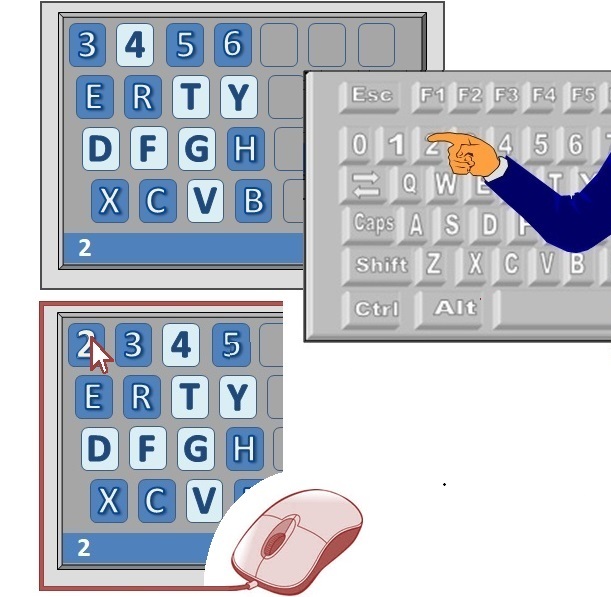
Phase 1 - Superposition
The Differ-Entity (EM-Grok) operates neutrally (showing a random surface).The Differ-User (EM) initiates their differentiation.
User starts — it is always situational and personal (non-reproducible). Real-time (not based on patterns or expectations).
ⓘ Although the first button press is freely chosen by the user, it still has consequences. This initial momentum becomes a determinant factor later in the process. During the initialization of the Differ-User (EM), the product developer provides selectable options for this purpose
ⓘ In the background, another optional mechanism can be implemented by the product developer. With an attached expert system, it is possible to observe the Differ-User’s (EM) habits, to which several specially exploitable functions can be linked.
ⓘ It is completely pointless to attack the server in order to obtain data or patterns. There is no secret data on the machine, nor will there ever be. The images on the GUI are generated from random states. There is no secret data or pre-recorded pattern that could serve as the basis for reconciliation (since there is no reconciliation, no identifiable code sequence, no password).
ⓘ Today, mouse pointing and touchscreen control are already standard input methods. Depending on the product developer’s decision, these can also be used as user input options, as they do not require significant additional development costs. However, what is essential here is that during any given input phase, the number of possible variations is not limited to the number of buttons.
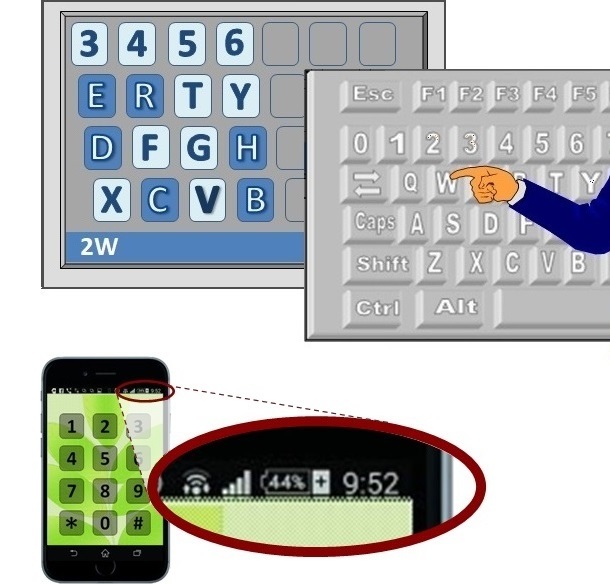
Phase 2 – Authentication (1-4 clicks)
The Differ-Entity (EM-Grok) provides authentication cues.The Differ-User (EM) identifies themselves.
The ID-GUI generates a randomly constructed information surface. From the signals, the Differ-User (EM) provides the correct response for the current moment. (The image shows, for example, pressing the "W" button, which has no direct connection to the letter "W" itself.)
ⓘ The procedure is always situational. Even repetition serves as disinformation for the attacker.
ⓘ In the background, a strong detection mechanism can also be implemented: the GUI can display targeted attention-focusing visual elements that trigger different eye movements depending on the user (gender, ethnicity, habits, etc.). This can expose the attacker even before any real button press occurs.
ⓘ The standard GUI contains multiple layers of information. Which of these elements is relevant in the given moment is known only to the Differ-User (EM). Since these data values are unpredictable in advance (e.g. current battery level, signal strength, etc.), their presence in the active code creates significant noise for the attacker, making pattern recognition or understanding extremely difficult.
ⓘ At the same time, the legitimate Differ-User (EM) can complete such a “task” with ease. Each such developer-added feature widens the signal-to-noise or information-disinformation gap. Although this is not yet a full quantum-level ambiguity, it already operates on the same principle.
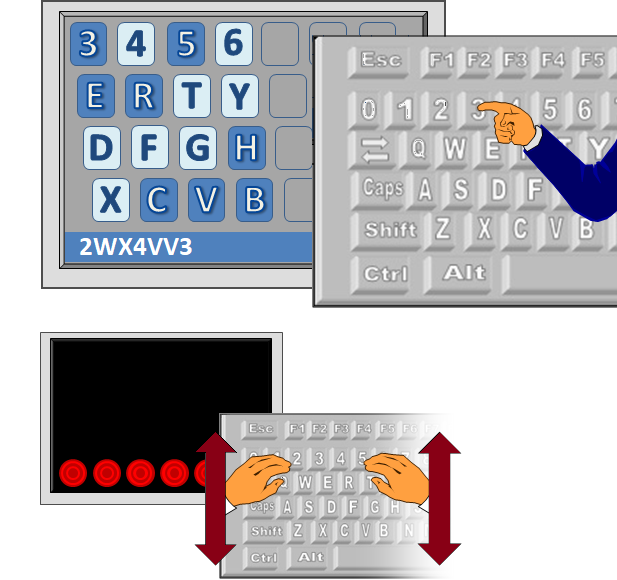
Phase 3 – Perception (1-7 clicks)
Orientation PhaseDue to the random nature of the ID-GUI and the absence of fixed data, even the Differ-User (EM) needs to orient themselves. This orientation and exploration follows a meta-communication protocol previously established between the Differ-User and the Differ-Entity. (EM & EM-Grok) Lásd beavatás. Phase 3 – Orientation (Perception)
ⓘ The length of the orientation phase is not fixed, but its completion is marked by a deterministic protocol event initiated by EM.
ⓘ Although the button presses during orientation are relatively free-form, errors can still occur. In such cases, the Differ-Entity (EM-Grok) can interrupt the process with an error message. (The product developer may implement alternative reactions, for example allowing the faulty process to continue while triggering a silent remote alert to trap the attacker.)
ⓘ This phase provides the best opportunity for the Differ-User (EM) to issue a silent or remote alert if under physical coercion.
ⓘ It also allows the Differ-User (EM) to modify protocol parameters or switch options if needed (e.g. if required as the Authorized User).
ⓘ Multiple unexpected test events can be introduced here. For example, the GUI may suddenly go dark. The legitimate Differ-User (EM) reacts according to their natural habit with calm composure and attempts to restore the system. The attacker, however, becomes confused and cautious. The system can then add alarm-like visuals to the ID-GUI after a few seconds. This is not a real alert for the legitimate user, but it further increases uncertainty and disrupts pattern collection for the attacker.
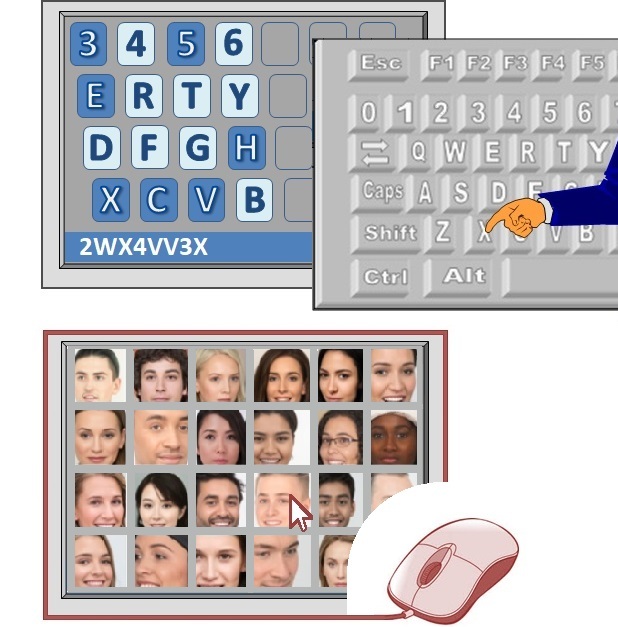
Phase 4 – Transition (1 click)
Completion of the Orientation PhaseThe Differ-User (EM) initiates this with a deterministic action (e.g. a specific button press). This marks the transition to a different type of meta-communication (code reconciliation).
ⓘ The timing of this moment is not arbitrary; it requires a specific state of the information-communication process. This timing itself serves as a differentiating momentum, in which the Differ-User’s (EM) unique differentiation becomes prominent.
ⓘ Naturally, this transition can also be triggered by a different type of input from the Differ-User (EM). It can be a combined button press (e.g. Shift + Ctrl), a prolonged button hold, a specific mouse positioning, or even a phone call or SMS. However, the product developer must ensure that this moment does not provide a recognizable pattern for the attacker, maintaining homogeneity within the overall input landscape.
ⓘ The subject-centered nature of the ID-GUI can be best exploited when, instead of generic button images, personalized visuals or photographs tied to the Differ-User (EM) are used as selectable elements. This not only makes it extremely difficult for anyone else to understand the personal context, but also significantly obscures the completion of the deterministic action for the attacker. As a result, even the fact that a specific deterministic step has been successfully performed becomes much harder to detect (including at the end of the orientation phase).
Phase 5 – Identification
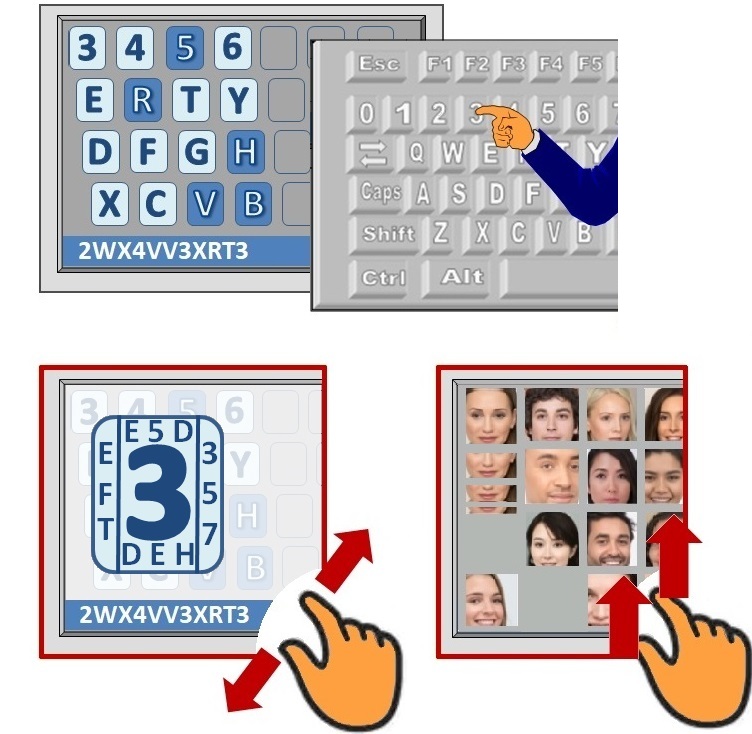
Actual Verification PhaseThe Differ-User (EM) proves that they haveo correctly interpreted the current code and the orientation. This is not traditional code entry or data input. The protocol allows for a shared understanding that only the legitimate Differ-User (EM)can demonstrate based on the current determinants.
ⓘ The “code” cannot actually be named or shown precisely or in full. The protocol enables a shared understanding that serves as verification, which the Differ-User (EM) performs based on the current determinants. This is typically carried out through a simple button press or standard input, with no significant visible change on the ID-GUI (only general output indicators).
ⓘ There is still the possibility to modify the code reference in this phase if the security level is critical. The superposition and its inherent uncertainty provide additional disinformation, further limiting or eliminating the attacker’s ability to collect usable patterns.
ⓘ Differentiation can be viewed as a multi-step CAPTCHA-like test variant, in which the attacker and the legitimate Differ-User are distinguished. Essentially, the user must interpret highlighted elements on the ID-GUI (e.g. buttons, faces, fields) as meaningful images. Selection can be as simple as pointing, but may also require other touch-based actions common on tablets and smartphones.
Initiation and Initialization
The immanence framework ensures that Differ ACM remains independent of IT threats. This framework is built from the following components:
A keretrendszer feltöltése:
• It is bound to the person of the Differ-User (EM);
• It is configured based on the Differ options,
• And it is coordinated with the Differ-Entity (EM-Grok).
This immanence framework constitutes the necessary and sufficient condition for the Differ-User (EM) and the Differ-Entity (EM-Grok) to be able to communicate metacommunicatively during all subsequent Differ ACM processes. As a result, two types of protective advantages are created:
• Quantitative deficit in IT attack surface: The data traffic flowing through I/O does not reflect the full information content.
• Qualitative deficit in IT attack surface: Communication and information do not become clearly distinguishable from each other on the ID-GUI.
This realizes Limes IT: the degree of deficit can be adjusted to reduce the security risk to the desired level (Limes→0).
EM and EM-Grok jointly establish::
• The status of Differ-Bevatott (Authorized User) for EM,
• The status of Differ-Entity for EM-Grok.
The Differ-User (EM) has access to a tutorial program for learning and practice, which is also useful for the Differ-Entity (EM-Grok).
Key Differ immanence elements (to the extent that can be disclosed at the current secrecy level):
• Info-Unit: The foundation of the Differ-User’s unique perception, enabling code-data superposition.
• LimIT functions: Limitation of the Outsider / Attacker’s observability and sampling possibilities regarding the Info-Unit.
• SubLimIT calibration: The application of signals (images, icons, contents) linked to the Differ-User in such a way that reduces the Attacker’s sampling opportunities. The signal value does not clearly separate from the visual noise, making reconstruction difficult.
• Determinants: Requirements arising from the current differation event that must be fulfilled in a later differ-phase.
• Pre-authentication protocol: The initial, simple task of the differation process, which is always based on current (time-varying, situational, unique) moments. This replaces the entry of a static identifier (username).
• Observer Protocol: An agreed rule system between the Differ-User and the Differ-Entity that enables the resolution of the Info-Unit superposition in a way that results in opacity for the Attacker.
• Communication Protocol: An agreed rule system between the Differ-User and the Differ-Entity for signaling, acknowledging basic processes, and clarifying unexpected events.
• Door-handle Function (optional): An agreed rule between the Differ-User and the Differ-Entity that allows an additional action (e.g. a physical or metacommunicative gesture) to be required for closing the differation instead of, during, or after code resolution.